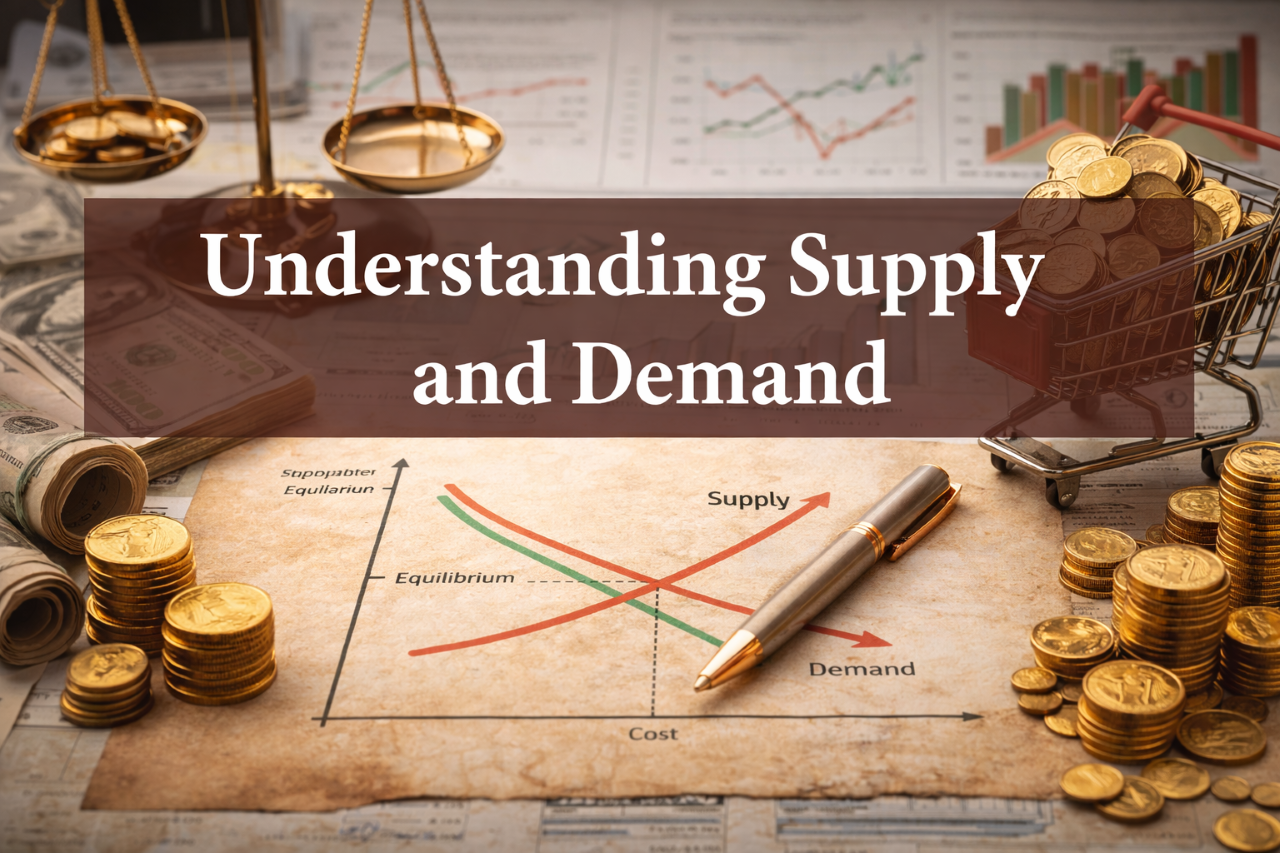
Supply and demand form the foundational framework of economic analysis. They are the most widely recognised concepts in microeconomics and serve as the intellectual cornerstone of market economics. Whether one is examining the price of petrol, rental rates in major cities, wages in the labour market, or fluctuations in global commodity prices, the principles of supply and demand remain essential interpretative tools. Despite their apparent simplicity, these concepts encompass complex behavioural patterns, theoretical models, institutional structures, and empirical realities. This article provides an extensive academic exploration of supply and demand, designed to offer readers a deep and nuanced understanding of how markets operate, how prices adjust, and how economic agents interact within a system characterised by scarcity, incentives, and choice.
Understanding the Nature of Demand
Demand refers to the quantity of a good or service that consumers are willing and able to purchase at various prices during a specified period. It is not merely a desire for something—a crucial distinction—but rather the willingness backed by purchasing power. The formal definition of demand incorporates income, preferences, expectations, and market conditions, reflecting the complex interplay of variables that determine consumer behaviour.
In traditional microeconomic theory, demand is modelled through the demand curve, which captures the relationship between the price of a good and the quantity demanded. The Law of Demand states that, ceteris paribus, there is an inverse relationship between price and quantity demanded: as price increases, quantity demanded decreases, and vice versa. This occurs due to two fundamental effects: the substitution effect and the income effect. The substitution effect reflects consumers’ tendency to switch to alternative goods when the price of one good rises. The income effect captures the reduction in purchasing power that results from higher prices. Together, these effects underpin the downward slope of the demand curve.
However, demand is not static. It shifts due to changes in non-price determinants such as income, tastes, population size, the price of related goods (substitutes and complements), and future expectations. For instance, a rise in consumer income may increase demand for normal goods but reduce demand for inferior goods. Similarly, expectations of future price increases (as in the housing market) may stimulate current demand. These shifts are represented graphically by movements of the demand curve rather than movements along the curve. Understanding these distinctions is essential for interpreting market behaviour accurately.
Elasticity of Demand: Measuring Responsiveness
Elasticity adds a critical dimension to the study of demand by measuring the responsiveness of quantity demanded to changes in price, income, or the price of other goods. Price elasticity of demand (PED) is the most widely used form and is defined as the percentage change in quantity demanded divided by the percentage change in price. Goods with elastic demand experience large changes in quantity demanded when prices change, while goods with inelastic demand experience only small changes.
A variety of factors influence elasticity: availability of substitutes, proportion of income spent on the good, necessity versus luxury status, time horizon, and market definition. For example, petrol in the short run tends to have inelastic demand because consumers cannot easily change their behaviour; however, in the long run, demand becomes more elastic as consumers adjust through carpooling, public transport, or fuel-efficient vehicles. Elasticity is crucial for understanding revenue effects, tax incidence, policymaking, and business strategy.
Cross elasticity of demand (XED) measures responsiveness to the price of related goods, distinguishing between substitutes (positive XED) and complements (negative XED). Income elasticity of demand (YED) measures how demand changes with income, classifying goods into normal, inferior, and luxury categories. These elasticity concepts are vital to sectors such as marketing, public finance, international trade, and strategic pricing.
Understanding the Nature of Supply
While demand reflects consumers’ side of the market, supply represents the producers’ side. Supply refers to the quantity of a good or service that producers are willing and able to offer for sale at various prices within a given timeframe. Like demand, supply reflects willingness and ability; firms’ decisions are shaped by production costs, technology, input prices, market structure, government regulations, and expectations of future prices.
The supply curve is typically upward sloping, demonstrating the Law of Supply: as the price increases, producers are incentivised to supply more. This positive relationship occurs because higher prices improve profitability, enabling firms to cover marginal costs and justify increased production. However, the shape of the supply curve varies across industries. In agriculture, for example, supply may be almost vertical in the short run due to biological constraints. In manufacturing, where capacity can be adjusted, supply is more elastic.
Non-price determinants of supply include input prices (e.g., rising wages increasing production costs), technological change (which improves productivity and shifts supply to the right), government taxes and subsidies, number of producers in the market, and expectations of future price changes. These determinants cause the entire supply curve to shift rather than movements along the curve.
Elasticity of Supply: Measuring Production Responsiveness
Elasticity of supply measures how responsive quantity supplied is to changes in price. Goods with elastic supply can be produced quickly and cheaply when prices rise; goods with inelastic supply face constraints, such as limited resources, capacity, or production timelines. Time is the most significant determinant of supply elasticity. In the very short run, supply is usually inelastic because production cannot change instantly. Over the long run, firms can expand capacity, hire more workers, invest in technology, or exit and enter the market, making supply more elastic.
Understanding elasticity of supply is essential for analysing policies such as minimum wage laws, rent controls, agricultural price supports, and government subsidies. It also plays an important role in explaining why some industries experience volatile prices: commodities with inelastic supply (e.g., oil, rare metals) often undergo large price swings when demand changes.
Market Equilibrium: The Interaction of Supply and Demand
Equilibrium is the point where the quantity demanded equals the quantity supplied. This point determines the market price and quantity traded. It is a key organising principle of competitive markets: neither buyers nor sellers have incentives to deviate from the equilibrium price. Graphically, equilibrium is shown at the intersection of the demand and supply curves.
When the price is above equilibrium, a surplus occurs. Producers supply more than consumers are willing to buy, putting downward pressure on prices. Conversely, when the price is below equilibrium, a shortage arises, pushing prices upward. These automatic adjustment processes demonstrate how markets coordinate the activities of millions of buyers and sellers without central planning.
Changes in demand or supply shift the equilibrium. For example, a rise in consumer income may increase demand for electronics, shifting the demand curve rightward and raising both equilibrium price and quantity. Likewise, a technological improvement that reduces production costs shifts supply rightward, decreasing equilibrium price and increasing quantity. These mechanisms help explain daily price fluctuations in goods such as food, energy, real estate, and labour.
Government Intervention: Price Controls and Market Distortion
Governments often intervene in markets to achieve social goals, correct market failures, or stabilise economic outcomes. Two common interventions are price ceilings and price floors. A price ceiling is a legally imposed maximum price, such as rent control. If set below equilibrium, it causes shortages: demand exceeds supply. In cities with rent control, this leads to housing shortages and reduced investment in maintenance. A price floor, such as minimum wages or agricultural support prices, sets a legally imposed minimum price. If set above equilibrium, it causes surpluses: supply exceeds demand. This is often seen in agricultural markets where government programmes purchase excess output.
Taxes also affect supply and demand by raising production costs or reducing disposable income. A tax shifts the supply curve leftward or the demand curve downward. The incidence of taxation—how the burden is shared between consumers and producers—depends on elasticities. If demand is inelastic, consumers bear most of the burden; if supply is inelastic, producers bear more. Subsidies shift supply rightward, lowering prices and increasing output, commonly used for agriculture, education, and renewable energy.
Market Adjustments and Dynamics
Real-world markets rarely operate in static equilibrium. Instead, they constantly adjust to new information, technology, shocks, and expectations. For instance, natural disasters may reduce supply, increasing prices sharply. Speculative demand can drive asset bubbles, as seen in housing or cryptocurrency markets. Globalisation can shift supply through changes in comparative advantage and international trade flows. Supply chain disruptions affect production costs and availability. These dynamics show that supply and demand analysis is not merely theoretical but crucial for understanding economic volatility and long-term adjustments.
In labour markets, supply and demand interact to determine wages. The supply of labour reflects workers’ decisions about employment, education, and lifestyle, while demand reflects employer needs and productivity. In financial markets, supply and demand determine interest rates, investment flows, and asset valuation. The universal applicability of supply and demand across economic domains demonstrates its analytical power.
Shifts versus Movements: A Critical Distinction
One of the most important intellectual distinctions in supply and demand analysis is between shifts of the curves and movements along the curves. A change in price causes movement along a curve but does not shift the curve itself. A shift occurs only when a non-price determinant changes. Misunderstanding this distinction leads to incorrect interpretations of market behaviour and flawed policy conclusions. For example, assuming that rising prices always reflect rising demand ignores the possibility of supply contraction. Accurate economic reasoning requires clear comprehension of these mechanisms.
Behavioural Insights and Real-World Deviations
While classical supply and demand analysis assumes rational behaviour, modern behavioural economics has shown that consumers often deviate from rationality through heuristics, biases, and emotional responses. For example, consumers may resist price increases for essential goods even if their budget allows, leading to brand loyalty or substitution delays. Producers may maintain prices during cost increases to preserve customer goodwill. Speculative bubbles reveal that demand can become highly elastic due to psychological expectations rather than intrinsic value.
These behavioural patterns enrich supply and demand theory by acknowledging the complexity of human decision-making in markets.
Summary and Insights
Supply and demand are indispensable components of economic theory, offering a systematic framework for understanding price formation, resource allocation, consumer behaviour, and producer decisions. Although the graphical models of supply and demand appear simple, their implications are profound and far-reaching. They explain how markets reach equilibrium, how prices adjust to shifts in conditions, how governments influence economic outcomes through policy interventions, and why markets experience volatility.
This extensive academic exploration demonstrates that supply and demand are not merely introductory concepts but powerful analytical tools that appear throughout microeconomics, macroeconomics, public policy, and business strategy. By mastering supply and demand, one gains a lens through which much of the economic world becomes comprehensible—whether interpreting inflation, housing crises, wage trends, or financial markets. Understanding these concepts equips students, researchers, and policymakers with the intellectual foundation necessary to analyse both everyday decisions and complex economic systems.