Inflation, unemployment, and Gross Domestic Product (GDP) are the three central pillars of macroeconomic analysis. They represent the most widely monitored indicators of economic performance and form the analytical foundation for government policy, academic research, and financial decision-making. Although each indicator encapsulates a distinct dimension of economic activity, they are deeply interrelated. A change in one often has consequences for the others, and together they shape our understanding of economic health, stability, and long-term development. This article provides an extensive and academically grounded exploration of inflation, unemployment, and GDP in British English, discussing their definitions, measurement techniques, theoretical underpinnings, causes, consequences, interrelationships, and policy implications.
Introduction to Macroeconomic Indicators
Macroeconomic indicators help economists and policymakers assess the state of the economy, diagnose problems, and design interventions. Inflation measures the rate at which prices rise; unemployment tracks the share of the labour force without work; GDP quantifies the total value of goods and services produced within a country. Together, they provide a comprehensive snapshot of economic activity: the speed of growth, the stability of prices, and the utilisation of labour resources.
These indicators are closely monitored by central banks, such as the Bank of England, and by international institutions including the International Monetary Fund (IMF) and the World Bank. Economic models such as the Phillips Curve, the AD–AS framework, and the Okun’s Law relationship rely on these variables to explain macroeconomic fluctuations. Understanding their behaviour is therefore essential for interpreting economic performance both in the short term and over long-run economic cycles.
Understanding GDP (Gross Domestic Product)
GDP is the monetary value of all final goods and services produced within a country’s borders during a specific time period, typically a quarter or a year. It is the most widely used measure of economic performance. Economists use GDP to evaluate growth, compare countries, track business cycles, and develop macroeconomic policy.
GDP can be measured in three principal ways: the production (output) approach, the income approach, and the expenditure approach. The production approach sums the value added at each stage of production across all industries. The income approach adds up all income earned from production, such as wages, rents, interest, and profits. The expenditure approach, the most common, calculates GDP using the formula:
GDP = C + I + G + (X – M)
Where:
C = Consumption
I = Investment
G = Government Spending
X – M = Net Exports
Real GDP is adjusted for inflation, while nominal GDP is not. Real GDP gives a clearer picture of economic growth by isolating quantity changes from price fluctuations. GDP per capita, meanwhile, divides total GDP by the population, providing a broad measure of living standards.
However, GDP has limitations. It does not measure inequality, non-market activities, environmental degradation, or overall well-being. As a result, alternative measures such as Gross National Income (GNI), the Human Development Index (HDI), and the Green GDP have been developed to provide more holistic assessments of economic welfare. Still, GDP remains the central indicator for tracking economic expansion and contraction.
Understanding Inflation
Inflation refers to the sustained increase in the general price level of goods and services. When inflation rises, each unit of currency buys fewer goods and services, eroding purchasing power. Economists measure inflation using price indices such as the Consumer Prices Index (CPI), the Retail Prices Index (RPI), and the GDP deflator. In the United Kingdom, the CPI is the primary measure.
Inflation can be classified into several types. Demand-pull inflation occurs when aggregate demand exceeds aggregate supply, often during periods of rapid economic expansion. Cost-push inflation arises when production costs increase—such as higher wages or raw material costs—leading firms to raise prices. Built-in inflation results from adaptive expectations, where workers demand higher wages to compensate for rising prices, thus creating a wage–price spiral.
Central banks aim to maintain price stability because high inflation reduces purchasing power, disrupts savings, discourages investment, and imposes uncertainty on businesses. Conversely, deflation, a persistent fall in prices, can also be harmful, encouraging consumers to postpone purchases and increasing the real burden of debt. Moderate inflation, typically around 2% per year, is considered optimal for economic stability.
Monetary policy plays a crucial role in controlling inflation. The Bank of England adjusts interest rates, manages money supply, and uses tools such as quantitative easing to influence inflationary pressures. Fiscal policy, such as changes in tax rates or government spending, can also affect inflation by influencing aggregate demand.
Understanding Unemployment
Unemployment occurs when individuals who are willing and able to work cannot find employment. It reflects underutilisation of labour resources and is a key indicator of economic distress. The unemployment rate is calculated as the percentage of the labour force that is unemployed.
Economists classify unemployment into several categories. Frictional unemployment arises from normal labour market turnover, as workers move between jobs. Structural unemployment results from mismatches between workers’ skills and job requirements, often due to technological change or shifts in demand. Cyclical unemployment occurs during economic downturns when aggregate demand falls and firms reduce production and hiring. Seasonal unemployment affects sectors that experience seasonal fluctuations, such as tourism or agriculture.
Unemployment has profound social and economic effects. It leads to lost output, reduced income, increased poverty, and psychological stress. High unemployment also strains public finances by increasing welfare spending and reducing tax revenue. Governments therefore deploy a variety of labour market policies to reduce unemployment, including job training programmes, employment subsidies, and public works projects.
The natural rate of unemployment—comprising frictional and structural unemployment—represents the level of unemployment consistent with stable inflation. This concept is crucial in macroeconomics, particularly in analysing the trade-off between inflation and unemployment.
Interrelationship Between Inflation, Unemployment, and GDP
Although inflation, unemployment, and GDP are distinct variables, they are closely interconnected through complex economic mechanisms. The most famous representation of this interrelationship is the Phillips Curve, which suggests an inverse relationship between inflation and unemployment in the short run. When unemployment falls, inflation tends to rise due to higher wages and increased spending; when unemployment rises, inflation tends to fall. However, this relationship weakens in the long run, as expectations adjust and the economy returns to the natural rate of unemployment.
GDP growth also interacts with inflation and unemployment. When GDP expands rapidly, unemployment tends to fall as firms hire more workers. However, rapid GDP growth can also trigger demand-pull inflation if production cannot keep pace with rising demand. Conversely, when GDP contracts, unemployment rises and inflation falls, which may lead to deflationary pressures.
Okun’s Law provides another connection, linking unemployment to GDP. It states that for every percentage point by which actual GDP falls below potential GDP, unemployment rises by approximately half a percentage point. This relationship helps policymakers estimate the output gap—an indication of whether an economy is overheating or underperforming.
The Aggregate Demand–Aggregate Supply (AD–AS) model further illustrates the interaction. A rightward shift in aggregate demand increases GDP and inflation while reducing unemployment. A leftward shift decreases GDP, raises unemployment, and lowers inflation. Aggregate supply shocks, such as oil price spikes, can cause stagflation—a combination of high inflation and high unemployment—challenging policymakers.
Policy Implications and Economic Management
Managing inflation, unemployment, and GDP requires careful coordination of monetary, fiscal, and labour market policies. Central banks primarily target inflation through interest rate adjustments. Raising interest rates slows economic activity and reduces inflationary pressures, while lowering rates stimulates spending but risks higher inflation.
Governments influence GDP and unemployment through fiscal policy. Expansionary policies—such as increased government spending or tax cuts—can boost GDP and reduce unemployment but may lead to higher inflation. Contractionary fiscal policies help cool an overheating economy but may raise unemployment.
Labour market policies, such as job training, minimum wage regulations, and employment subsidies, affect unemployment directly. Structural reforms aimed at improving productivity and competitiveness also influence GDP growth in the long term.
Since inflation, unemployment, and GDP often move in different directions, policymakers must balance trade-offs. For example, reducing inflation may require slowing economic growth, while boosting GDP may risk triggering inflation. Effective policy requires forward-looking strategies, robust data analysis, and an understanding of underlying structural conditions.
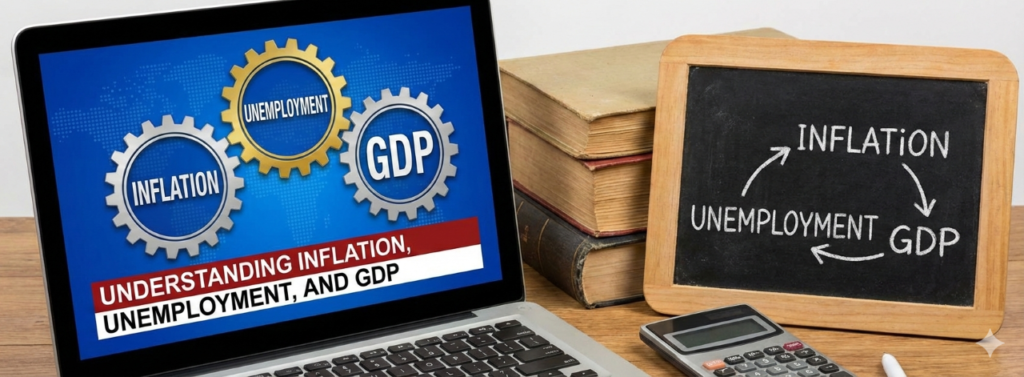
Inflation, unemployment, and GDP are the most critical indicators for assessing macroeconomic performance. They shape economic policy, influence public debate, and affect the daily lives of individuals and businesses. Understanding how they are measured, what drives them, and how they interact is essential for analysing economic health and designing effective policies. While these indicators offer powerful insights, they also present challenges due to the complexity of economic systems. The interrelationships between inflation, unemployment, and GDP reveal the delicate balance that policymakers must maintain to ensure stable and sustainable economic growth. By studying these indicators within a theoretical and empirical framework, we gain a deeper appreciation of the forces shaping national and global economies.